

Arizona State University Accelerates Low-Dose Dynamic TEM with SenseAI Enhance
Revealing atomic-scale catalyst dynamics without the need for high-performance computing.
The School for Engineering of Matter, Transport and Energy is part of the Ira A. Fulton Schools of Engineering at Arizona State University. With programs in mechanical engineering, chemical engineering, materials science and engineering and aerospace engineering, the school used imaging and electron microscopy to explore the structure, composition, and properties of materials at micro- to atomic scales.
The Challenge
Understanding how catalysts work requires researchers to observe individual atoms as they move, rearrange and grow under realistic operating conditions. Modern direct electron detectors make it possible to capture these processes at millisecond timescales, but doing so introduces a fundamental challenge.
To achieve frame rates of around 10–100 ms per image, only a very small number of electrons can be collected in each frame. The resulting low-dose images are dominated by shot noise, obscuring the subtle atomic-scale features needed to understand catalytic behaviour.
Increasing the electron dose improves image quality but risks damaging the specimen or altering the very processes under investigation. This dose–time trade-off is one of the fundamental limitations of dynamic transmission electron microscopy.
Existing approaches to overcome this limitation include AI models trained using extensive simulated or experimental datasets but they often require significant GPU or high-performance computing (HPC) resources, making them computationally demanding and are not always practical for routine day-to-day experimental workflows.
The Solution
Arizona State University deployed SenseAI Enhance, a post-processing software suite which, rather than relying on extensive training and fine tuning of deep neural networks or microscope-specific models, exploits the spatial and temporal redundancy naturally present within each recorded image sequence to suppress noise and recover fine structural detail. It can work on both static images and video, processing complete datasets locally on a standard workstation. The end result is a rapid reconstruction shortly after acquisition without requiring dedicated AI infrastructure or model training.
Because the approach operates directly on the acquired experimental data in a close-formed solution, it avoids the dependency on extensive parameter tuning and reduces concerns associated with learned image priors.
Results
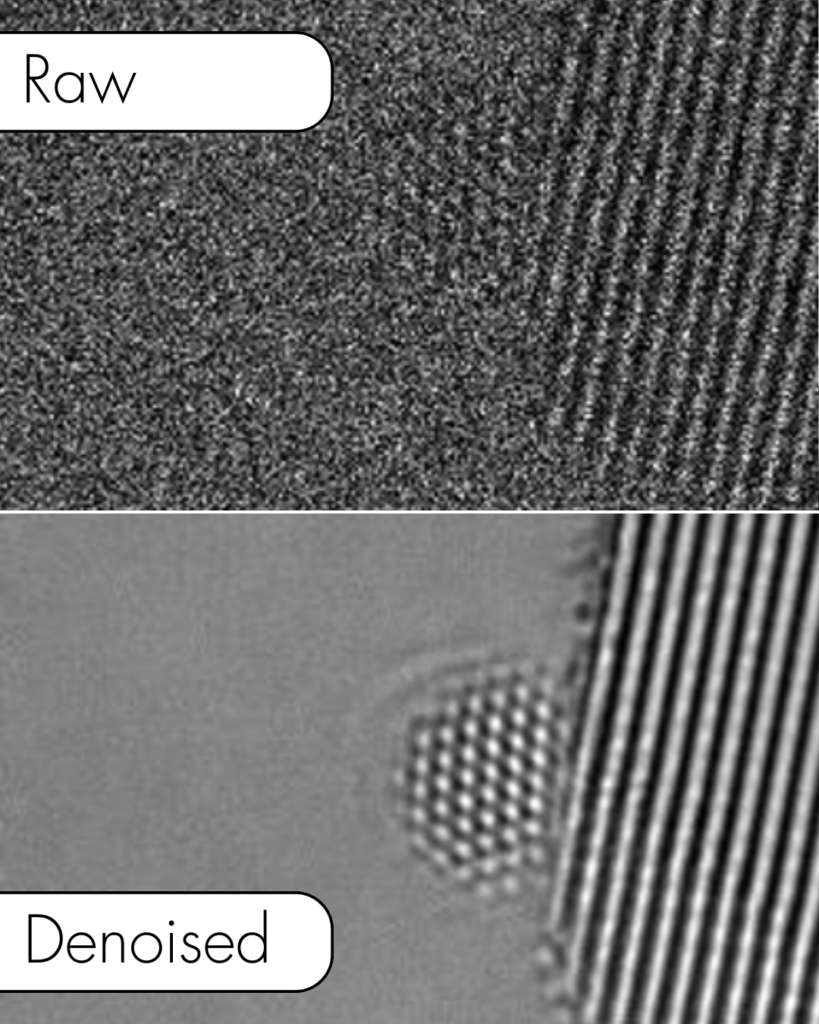
Using dynamic TEM video data acquired on a Gatan K3 direct electron detector, SenseAI Enhance significantly improved the visibility of atomic-scale features in extremely noisy image sequences.
Measured signal-to-noise ratio (SNR), calculated using the Median Absolute Deviation (MAD) method, increased by over 30dB following enhancement.
This improvement corresponds to image quality comparable to acquiring approximately 1000x more electrons, enabling researchers to achieve:
- up to 1000× lower electron dose for equivalent image quality, helping to minimise beam damage to sensitive materials; or
- up to 1000× higher effective temporal resolution for equivalent SNR, allowing significantly faster dynamic imaging.
Processing approximately 1,000 1k × 1k image frames typically requires only 5–20 minutes on a standard desktop PC, providing a practical near-real-time workflow immediately following acquisition.
“Our group develops advanced AI methods for recovering information from extremely noisy TEM data. What impressed me about SenseAI Enhance was that it works across both video and static data to deliver the practical capability we need for routine analysis directly on a standard workstation, rather than requiring dedicated high-performance computing resources. It has become an extremely valuable first step in our workflow for analysing low-dose dynamic TEM experiments.”
Professor Peter Crozier
Arizona State University